If a cognizable offence has happened, you can give information at any police station, even if the crime took place elsewhere, and you can also start that information online. Section 173 of the Bharatiya Nagarik Suraksha Sanhita, 2023 (BNSS) is the rule for that First Information Report (FIR): zero FIR, e-FIR, a free copy, and what to do if the station refuses.
What this right / rule is
An FIR is the first information of a cognizable offence recorded by the officer in charge of a police station. Cognizable means the police may investigate without a Magistrate’s prior permission for arrest in the usual course. The old label was section 154 of the Code of Criminal Procedure, 1973 (CrPC). From 1 July 2024 the same subject sits in section 173 of the BNSS.
Two ideas people search for are written into that section:
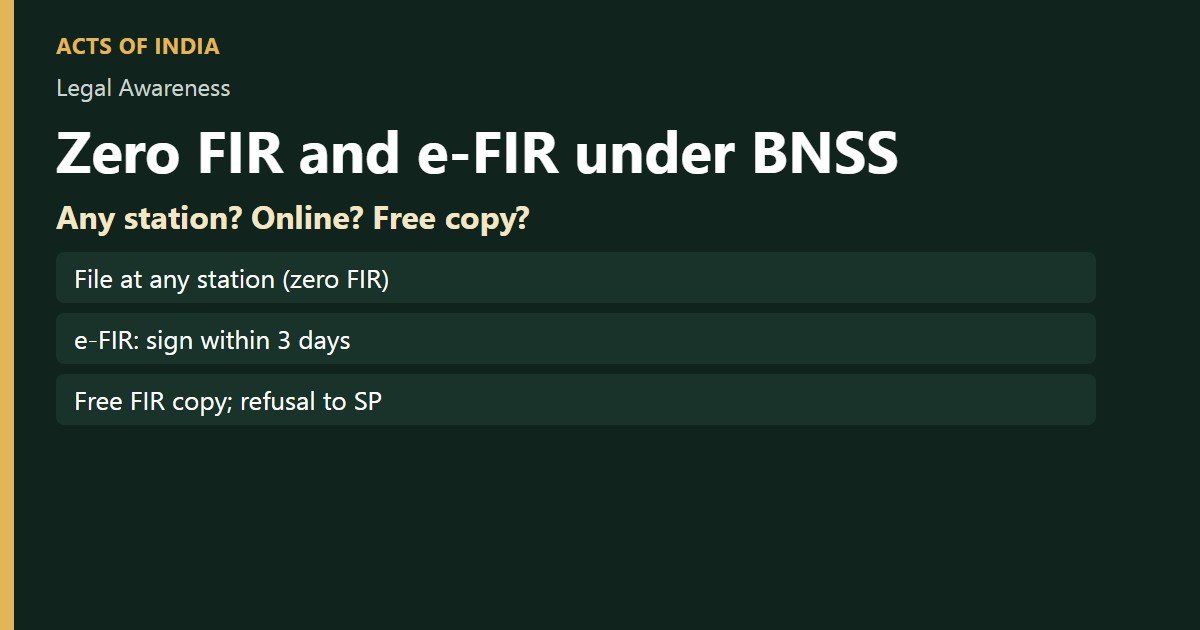
- Zero FIR — information may be given “irrespective of the area where the offence is committed.” You need not first find the “right” local station.
- e-FIR — information may be given “by electronic communication,” but it is taken on record only after you sign it within three days.
Section 173(2) says a copy of the recorded information must be given forthwith, free of cost, to the informant or the victim. Keep that copy; the FIR number, date and sections matter for every later step.
When it applies
Use section 173 when you are reporting a cognizable offence: theft, robbery, assault causing serious hurt, many cyber frauds once they meet the threshold of a cognizable offence, and similar crimes listed as cognizable in the Bharatiya Nyaya Sanhita, 2023 (BNS) or other special laws. A purely civil money dispute, a landlord–tenant quarrel without a cognizable offence, or a non-cognizable insult is not the same route; those often need a complaint before a Magistrate under other BNSS provisions.
Anyone who knows of the offence can give information — the victim, a witness, or another person with knowledge. You do not have to be the person who was harmed. A police officer who learns of a cognizable offence can also register information.
Online filing is not identical in every state. Many state police citizen portals accept certain categories first (for example vehicle theft or lost property) and still ask you to visit for serious or violent offences. Section 173 allows electronic communication in law; your state’s portal decides the practical menu. For money lost to online fraud, the national route many people use first is cybercrime.gov.in and helpline 1930 — see also our guide on 1930 and the cyber portal.
Step-by-step what to do
- Decide urgency. If there is danger now, call 112 or go to the nearest station. Do not wait for a portal.
- Zero FIR in person. Go to the nearest police station. Say you want to report a cognizable offence and register an FIR. Give facts in order: what happened, when, where, who if known, witnesses, and evidence. If you speak, the officer must reduce it to writing and read it over before you sign (section 173(1)(i)). Do not sign what you have not understood. Ask for your free copy at once.
- If they say “wrong station”. Point to the words “irrespective of the area” in section 173(1). The receiving station can take a zero / temporary entry and transfer it to the station with territorial jurisdiction for a regular number and investigation.
- e-FIR / portal. Open your state police citizen portal (search the official state police site for citizen services / e-FIR / complaint). Register with mobile OTP where required. Choose the correct service. Fill details, upload copies of bills, screenshots or medical papers if you have them, submit, and save the acknowledgement number. Under section 173(1)(ii), sign within three days by the method your state provides (often a station visit) so the information is taken on record.
- Preliminary enquiry window. For some offences punishable with three years or more but less than seven years, section 173(3) allows a short preliminary enquiry (up to fourteen days) with prior permission of an officer not below Deputy Superintendent of Police, before deciding whether to proceed with investigation when a prima facie case exists. This is not a licence to ignore a clear cognizable case forever; it is a limited statutory option.
- If the station refuses. Under section 173(4), send the substance of the information in writing by post to the Superintendent of Police. If satisfied that a cognizable offence is disclosed, the SP must investigate or direct investigation. If that also fails, you may apply to the Magistrate.
Useful to carry (not legal conditions for registering): identity proof, a written timeline, copies (not originals) of supporting papers, and witness contacts.
Which law and section
- Bharatiya Nagarik Suraksha Sanhita, 2023 — section 173 (information in cognizable cases; replaces CrPC 154).
- Woman informants for certain sexual offences under listed BNS sections: information is to be recorded by a woman police officer or woman officer (first proviso to section 173(1)). Further safeguards apply where the person is disabled (recording at a convenient place, videography, and a Magistrate’s statement under section 183 as soon as possible).
- Related procedure for how police investigate after information is recorded continues in the same Chapter of the BNSS (including powers around section 174 and following provisions). Read the section text on our site for the exact words.
Common mistakes
- Waiting for the “correct” local station when any station can take a zero FIR for a cognizable offence.
- Treating a portal acknowledgement as finished business without signing an electronic FIR within three days.
- Assuming every offence can be completed fully online in every state — portals differ; serious or violent matters usually need the station or 112.
- Using rtionline or a cyber portal for the wrong kind of grievance; match the portal to the problem (police citizen portal / e-FIR vs cybercrime.gov.in for many online frauds).
- Leaving without the free FIR copy.
- Signing an oral complaint that was not read back to you.
Where to get help
- Emergency: 112.
- Online fraud reporting: cybercrime.gov.in · helpline 1930.
- State police official website → Citizen services / e-FIR / complaints (use only the government domain).
- Refusal to register: written information to the Superintendent of Police, then Magistrate under section 173(4).
- If you cannot afford a lawyer: NALSA helpline 15100 · our guide on free legal aid.
Sources
- BNSS section 173 (India Code text on Acts of India).
- Karnataka State Police public note on FIR under BNSS section 173 (citizen guidance on who may lodge and free copy).
- National Cyber Crime Reporting Portal — cybercrime.gov.in.
- Comparative explainers summarising state portal practice for e-FIR (confirm your own state’s official portal before you file).
This guide is based on the BNSS text and public police / portal materials. It is not legal advice. Procedures and portal menus differ by state; check the official site for your state before you rely on any step.