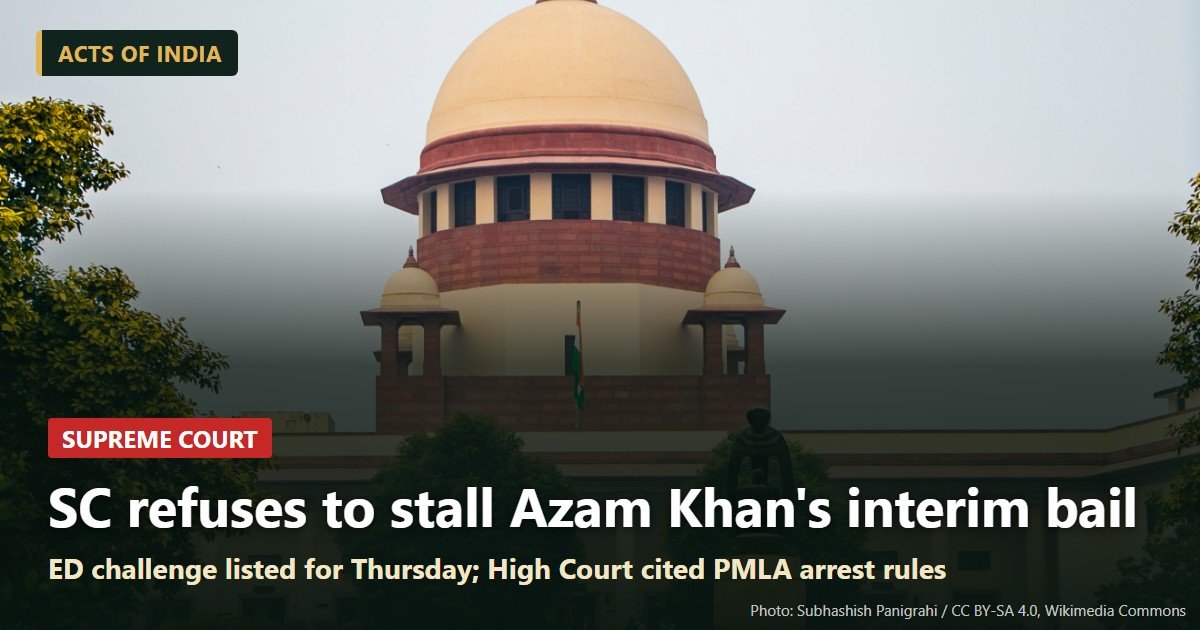
The Supreme Court on 18 November 2026 refused to put on hold the release of Samajwadi Party leader Mohammad Azam Khan on interim bail in an Enforcement Directorate money-laundering case, while agreeing to hear the ED’s challenge to the Allahabad High Court order on Thursday. A bench led by Chief Justice of India Surya Kant, with Justice Joymalya Bagchi, declined an urgent stay sought by the agency. Justice Bagchi remarked that Khan could remain on interim bail and that “heavens will not fall.”
What is the story
On 17 November 2026, a Division Bench of the Allahabad High Court (Justices Rajiv Gupta and Devendra Singh) granted Khan interim bail in a Prevention of Money Laundering Act (PMLA) case linked to alleged irregularities around the Maulana Mohammad Ali Jauhar Trust and Mohammad Ali Jauhar University. The High Court was prima facie satisfied that mandatory arrest safeguards under Article 22(1) of the Constitution and Section 19 of the PMLA had not been strictly followed. The next High Court date is 10 December 2026.
Khan was arrested by the ED on 31 October 2026 outside Rampur district jail, shortly after he was released on bail in a separate forgery / PAN-card related matter. The High Court treated the timing of that arrest as pointing to a “motivated and mala fide” exercise, on a prima facie view. The ED disputes that characterisation.
What happened in court
Solicitor General SV Raju, appearing for the ED, sought an immediate hearing and a status quo so that Khan would not be released before the Supreme Court heard the challenge. He argued that the High Court had spoken as if the trial were already decided and had labelled the investigation “malafide.”
CJI Surya Kant refused to take the matter on the same day: “No. Not today. You argue all these points before the court concerned tomorrow.” When a stay until Thursday was pressed, Justice Bagchi declined, saying Khan could remain on interim bail. The ED’s challenge is listed for Thursday.
Separately, in related family proceedings, a Supreme Court bench of Justices Dipankar Datta and Sheel Nagu cautioned that a stay of conviction cannot be sought only to chase electoral calendars, while balancing Article 21 dignity concerns under the revisional stay power that courts treat with the older CrPC language of Section 389(1). That bench allowed stays of conviction for Mohammad Abdullah Azam Khan and Dr Tazeen Fatma pending revision, and dismissed the Uttar Pradesh government’s challenge to the High Court’s stay of Azam Khan’s own conviction in the birth-certificate case. Those conviction-stay points are a different track from the PMLA interim bail fight.
Which law and section
The High Court order turns on arrest safeguards, not on a final finding that the PMLA allegations are false.
- Article 22(1) of the Constitution — a person who is arrested must be informed of the grounds of arrest and cannot be denied the right to consult and be defended by a lawyer of their choice.
- PMLA Section 19 — power to arrest. The officer must have a written “reason to believe” that the person is guilty of an offence under the Act, and the person must be informed of the grounds of arrest. Courts have insisted that these grounds be given in writing in a meaningful way, not only orally after the fact.
- Prevention of Money Laundering Act, 2002 — the parent statute for ED attachment and prosecution in this trust / university money trail, which remains pending. Allegations stay allegations until proved.
The High Court noted, among other points reported in the press, that arrest papers and grounds did not appear to have been furnished in writing before remand in the way the record required; that place, date and time fields on the grounds document were left blank; that grounds were not attached to a WhatsApp message later sent to a family member; and that although the ED said the arrest was videographed, it had not produced video or photos showing Khan being asked to receive the grounds and refusing them.
What happens next
The Supreme Court will hear the ED’s challenge on Thursday. Until then, the Allahabad High Court’s interim bail stands. The High Court has fixed the writ for further hearing on 10 December 2026 and has given the ED time to file a detailed reply. Nothing in today’s Supreme Court listing decides whether the PMLA case itself succeeds or fails.
What it means for you
For ordinary readers, the takeaway is procedural: when an agency arrests someone under special statutes such as the PMLA, courts look closely at whether the written “grounds of arrest” and other mandatory steps were actually followed. A High Court can grant interim bail if those steps look incomplete on the record, even while the investigation continues. A stay of conviction in a different criminal case is a separate remedy and, the Supreme Court has said again, cannot be treated as a shortcut only for elections.
This report does not say Azam Khan is guilty or innocent of money laundering. It explains what two courts have ordered so far, and which arrest rules they cited.
Sources
- Hindustan Times, 18 November 2026 — Supreme Court refuses to stall Azam Khan’s release; “heavens will not fall”
- LiveLaw, 17–18 November 2026 — Allahabad High Court interim bail; Section 19 / Article 22 findings; stay-of-conviction judgment
- The Hindu / Indian Express / India Today, 17–18 November 2026 — corroborating reports of High Court interim bail and ED challenge
This article is based on public reports and court records. It is not legal advice.