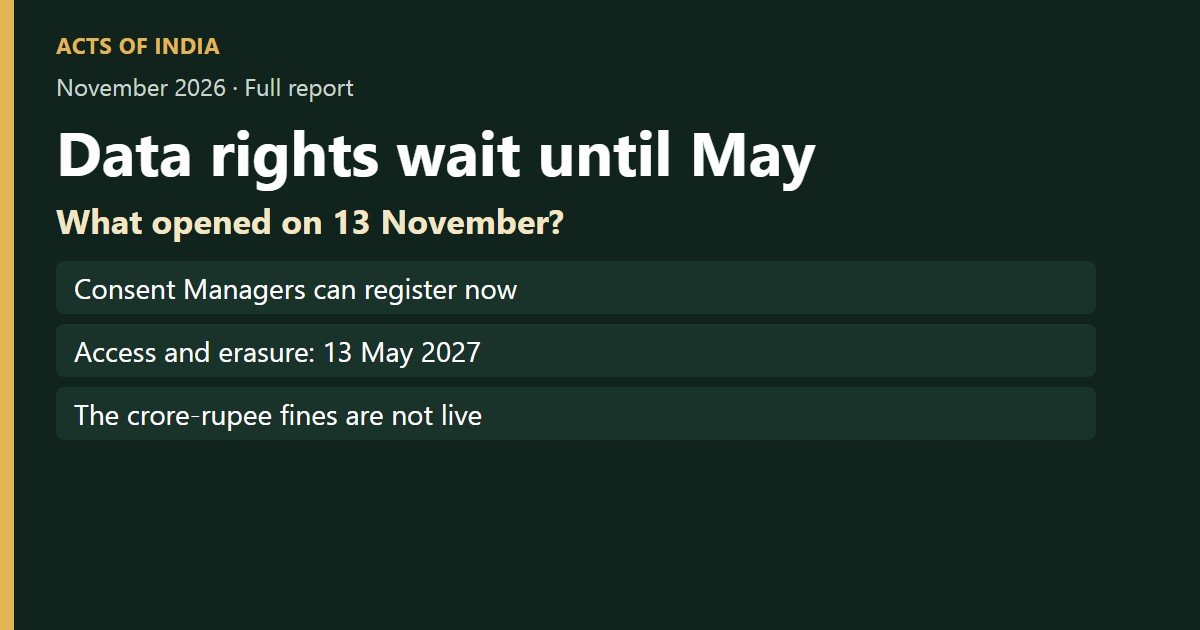
On 13 November 2026 the Government opened registration for Consent Managers under the Digital Personal Data Protection Act, 2023. That is not the day your right to see, correct or delete your data began. Those rights, the duties of companies, and the Board’s power to fine them are timed for 13 May 2027.
Headlines this week can be read as if the new data law is fully in force. The gazette splits the start into three dates. This guide says what each date actually switches on, what you can do today, and what is still a right on paper.
The three start dates
The Central Government used section 1(2) of the Act to appoint the dates in notification G.S.R. 843(E), dated 13 November 2025.
- 13 November 2025, the day the notification was published. Definitions, the machinery for setting up the Data Protection Board, and several final provisions. Not the rights chapter.
- One year later: 13 November 2026. Section 6(9), which requires every Consent Manager to be registered with the Board, and section 27(1)(d), the Board’s power to act when it is told that a registration condition has been broken. The Ministry of Electronics and Information Technology opened the application portal the same week.
- Eighteen months after that notification. Sections 3 to 5, most of section 6, sections 7 to 17, the rest of the Board’s inquiry powers, and the penalty provision. The Ministry has treated that date as 13 May 2027. A Press Information Bureau release on 14 November 2026 says the rights of individuals, the duties of companies, and the Board’s inquiry and penalty process are scheduled for that day.
What a Consent Manager is
Section 2(g) defines a Consent Manager as a person registered with the Board who is a single point of contact, so that you can give, manage, review and withdraw consent through one accessible and interoperable platform.
Section 6(9), the piece that is in force now, is short: every Consent Manager must be registered with the Board, in the manner and on the technical, operational and financial conditions the rules prescribe. It does not, by itself, give you a working button inside every app.
The Ministry’s release describes who may apply:
- A company incorporated in India.
- Enough technical, operational and financial capacity.
- Net worth of not less than ₹2 crore.
- Applications go through dpbi.gov.in.
- The Board decides whether to register. The list of registered Consent Managers is to be published on the Board’s website.
Until a name is on that public list, a website or an app claiming to be a “registered Consent Manager” has nothing you can check. Do not hand a private firm your passwords, OTPs or identity scans because it says it will “manage your consent”.
The rights that are still waiting
These are written in the Act. Under G.S.R. 843(E) they are in the eighteen-month group, so they are not the law you can enforce today. From 13 May 2027, as the Ministry has scheduled it, they are the core of the law.
- A summary of your data. Section 11: from a company you have already consented to, a summary of the personal data it is processing, what it is doing with that data, and, with some exceptions, who else received it.
- Correction and deletion. Section 12: correction, completion and updating of inaccurate or incomplete data, and erasure when you request it in the prescribed way.
- A grievance, then the Board. Section 13: you go to the company first. Only after you have exhausted that, or if it does not reply within the prescribed period, may you complain to the Board. Rule 14 of the DPDP Rules, 2025, which itself starts with the eighteen-month group, tells companies to answer grievances within a reasonable period not exceeding 90 days.
- A nominee. Section 14: you may nominate another individual to exercise these rights if you die or become unable to.
- Consent you can take back. Section 6(1) to (8) and (10) are in the same later group. When they start, consent has to be free, specific, informed, unconditional and unambiguous, and withdrawing it must be as easy as giving it. Section 6(7), the right to do that through a Consent Manager, starts then, not this week. A term that tries to make you waive the right to complain to the Board is invalid to that extent. The Act’s own illustration says so.
Fines are in the Act. They are not live yet.
Section 33 and the Schedule set the ceilings. They are part of the eighteen-month commencement, so the Board cannot impose them today. When they apply, the ceilings include:
- Up to ₹250 crore for failing to take reasonable security safeguards against a personal-data breach.
- Up to ₹200 crore for failing to tell the Board and the affected person about a breach, and the same ceiling for the extra duties towards children.
- Up to ₹150 crore for a Significant Data Fiduciary that misses its extra duties.
- Up to ₹50 crore for any other breach of the Act or the rules.
- Up to ₹10,000 where the breach is of the duties the Act places on you, the individual, under section 15. Those duties include not impersonating another person and not filing a false or frivolous complaint. The large crore figures are aimed at organisations, not at someone asking for their own data.
The Board must give a hearing before it imposes a penalty, and it has to weigh whether the amount is proportionate.
What you can actually do before May 2027
- Do not treat a privacy pop-up as the new Act. A company can still ask for consent. Until 13 May 2027 it is not yet bound by the Act’s consent tests, erasure right or Board fines.
- The older route is still on the statute book. Section 44(2) of the DPDP Act, which deletes section 43A of the Information Technology Act, 2000, is also in the eighteen-month group. Until that deletion takes effect, section 43A still says a company that is negligent with sensitive personal data in a computer resource, and thereby causes wrongful loss or gain, is liable to pay compensation. That is a claim about negligence and loss. It is not the new right to a summary or to erasure.
- Keep the record. If an app is using data you did not agree to, save the screen, the date and any email. That file is what a later request or complaint will need. It does not create a Board case today.
- Wait for the public list. Use a Consent Manager only after its name is on the list the Board publishes. Registration opened so that firms can get ready. It did not appoint one for you.
Questions people are asking this week
Can I complain to the Data Protection Board today?
Not for the rights in sections 11 to 14. The Ministry has said the rights, the companies’ duties, and the inquiry and penalty process start on 13 May 2027. The power that is already in force is narrower: acting on a report that a Consent Manager broke a condition of its registration.
Is dpbi.gov.in a place for citizens to file a case?
No. The portal launched this week is for companies applying to be registered as Consent Managers. Queries about that framework go to secretary@dpbi.gov.in, as the Ministry’s release states.
Does “withdraw consent” work in every app now?
No. The sections that require withdrawal to be as easy as consent, and that let you do it through a Consent Manager, start with the May 2027 group.
Are the crore-rupee fines already payable?
No. They sit in the Schedule to section 33, and that penalty provision is in the eighteen-month group.
Sources
- Gazette notification G.S.R. 843(E), 13 November 2025, appointing the three commencement dates
- PIB, 14 November 2026: Consent Manager registration framework and the dpbi.gov.in portal
- Digital Personal Data Protection Act, 2023, official PDF (MeitY), especially sections 2(g), 6, 11 to 15, 27, 33 and the Schedule
- Information Technology Act, 2000, section 43A, still the compensation section until section 44(2) of the DPDP Act takes effect
- Acts of India listing for the Digital Personal Data Protection Act, 2023. The section text is not loaded on this site yet; use the MeitY PDF above for the wording.
This article is general information, not legal advice. Acts of India is not a law firm. Commencement depends on the gazette notification, not on a headline. Check MeitY and the Board’s site before you rely on a date in a dispute.